

Custer County
IDGenWeb

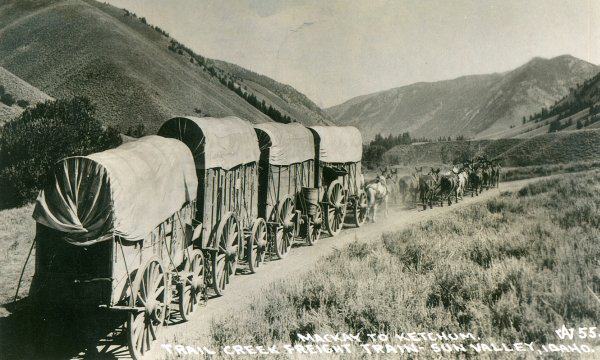
Trail Creek Freight Train from Makay to Sun Valley
Contributed by Earl A. Lockie, President of the South Custer County Historical Society (SCCHS)
Challis, the county seat of Custer county, and one of its earliest towns, is
still in existence and has increased to a population of about 500 at the present
time. It was laid out in January, 1878. by S. G. Fisher and James H. Vancamp,
according to Mrs. Vancamp, who is now living in Challis. The name is in honor of
Alvah P. Challis. Mr. Challis mined all over the west, coming to Leesburg in
1867 and then to Loon Creek when the stampede was on. He came to Round Valley,
the name of the valley in which Challis is located, and settled on Challis
creek, a small stream about four miles north of Challis. He was one of the
earliest of the white settlers in this part of the country where he, with his
partner, raised cattle. Cattle business was not a success for him; instead, it
caused him to go heavily in debt. He soon quit the cattle business and started
placer mining again to defray expenses incurred while stock raising. He went to
Stanley Basin — the group of claims now owned by his estate and by Mr. Sturkey.
He was one of our noble pioneers; returning east in the fall of 1902 he passed
away April 17, 1903, at Carbonsdale, Indiana.
The town is beautifully
located under the overhanging brown cliffs, and looking out over the valley from
Lone Pine Summit one sees a vast extent of mountains, each successive range
rising higher and higher, like a vast ampitheatre. This mountain to the north of
the town is a creamy mass of chlorite studding which contains a valuable supply
of building stone of which the Challis High School is constructed. It is at the
mouth of the canyon where Garden Creek flows out into the fertile valley and
about three miles from the Salmon river. This river, with its rugged buttes and
towering cliffs overlooking it, wends its way to the northward.
The fort
which was made of stone and post in the summer of 1878 in Challis, on account of
hostile Indians, does not stand. It covered the territory near the Challis
cemetery and the home of Mrs. Hess, Mrs. Vancamp, Henry Nichols and others
living in that vicinity. An old well which was used inside the fort can still be
seen just below the home of Mr. and Mrs. Nichols; it is now nearly filled with
earth. This fort was used only when the Indians were near. The homes were built
along the creek, the first home still standing in a prominent position on Main
street. It was built by ''Doc" Stores. Another old building across the street
from the Challis post office was built in 1897, as the date is written on the
front. It was a meat market but now it is abandoned. The first school house
stood where the old fox farm was. The first school teacher, Mr. Hainey, was a
lawyer and later became well known. The logs of the old schoolhouse are now in
the Garden Creek Cash Grocery on Main street, owned by John L. Hammond. Challis
had a setback by fire on April 25, 1894, which took the most of the business
section. Two of the old pioneers who were in the fort in 1878 are still living
in Challis. They are Mrs. Funkhouser and Mrs. Vancamp, who can relate many
exciting and hair-raising tales of those days. J. D. Wood was the first
postmaster, who later became the head of the Wood's Livestock company.
Source: 1900 History of Custer County by Jesse R. Black, pages 11-12
Custer county, named after General Custer, cut off from Alturas and Lemhi in
1881, proved inconsiderable as an agricultural region. There was a fine valley,
forty miles long by from five to fifteen miles wide on the upper Salmon River,
furnished with wood, water, and grass in abundance, and numerous small tracts of
agricultural land along the streams, but the county was preeminently a mining
country. In 1866 or 1867 a party of prospectors from Montana, headed by one
Richardson, penetrated to that branch of the Salmon which they named Yankee
Fork, because the party consisted of New Englanders. They did not remain long in
the country, which was at the best inhospitably strange and remote. In 1873 D.
V. Varney and Sylvester Jordan found their way to Yankee Fork and located some
placer mining claims, naming Jordan Creek branch of that stream. Four years
later the great discoveries were made in quartz, of the Charles Dickens, Charles
Wayne, Custer, and Unknown, which led to the hasty populating of this rich
mining region, among the most famous districts of which are the Kinnikinick, Bay
Horse, and Custer. Bonanza City was laid off in 1877.
The first trading
establishment was opened by George L. Shoup and his partner Boggs. Mark Musgrove
started a newspaper July 24, 1870, the Yankee Fork Herald. Challis, the county
seat, the centre of a large and rich mining district on the upper waters of the
Salmon River, was founded in 1878 by A. P. Challis and others, and had in 1880 a
population of 500. A newspaper called the Messenger was published here. There
were a number of mining camps in Custer county — Galena, Robinson's Bar, Jordan
Creek, Crystal City, Lost River, Clayton, Concord, Bay Horse, Custer, Cape Horn,
Oro Grande, Round Valley, and Fisher. The population of the county in 1883 was
3,000, and the assessed value of real and personal property the previous year
was $389,475.
Source: 1890 The Works of Hubert Howe Bancroft, Volume XXXI, pages 551-552
Four counties were declared Saturday to be in a state of martial law, in a proclamation by Governor C. Ben Ross. The counties are Boise, Gem, Valley and Idaho counties where the forest fire situation has been grave in recent weeks. The Governor said, "it has been made to appear to my satisfaction that many of said fires are of incendiary origin", after a conference of state officials, national guard and forest service officials at which the whole situation was thoroughly canvased. --Idaho Daily Statesman, August 30
In a relentless campaign to prevent incendiarism, five rifle, a machine gun company and two medical units of the Idaho National Guards are patrolling roads in four Idaho counties.
The new unit will have the patrol of roads, particularly the North and South Highway in Adams County, with a station at New Meadows. In Idaho county, the posts are at Burgdorf, Warren and Riggins. In Valley County, they are patroling the highway through McCall and Cascade. --Idaho Daily Statesman, September 1
Note: During these depressed times, the men who are fighting the fires are employed by the National Forests, their jobs ending when the fires are put out. There have been many reports that fires are started in order to continue employment.
Martial law in the timbered areas of central and southern Idaho was ended
last Thursday and the troops were recalled from the seven counties in which they
held sway for a ten day period.
Withdrawal of the troops followed a
series of cold nights, showers and snow which reduced the fire hazards,
particularly in the higher altitudes.
Counties included in the restricted
area were: Idaho, Boise, Gem, Valley, Adams, Custer, and Lemhi.
--Idaho Daily Statesman, September 17
Source: A Collection of News about Warren, Idaho by Cheryl Helmer, 1988, as abstracted from Warren Times.
Source: Mark Metkin's old "Idaho Post Office" website
Copyright © 1996- The USGenWeb® Project, IDGenWeb, Custer County

This page was last updated
07/22/2026